
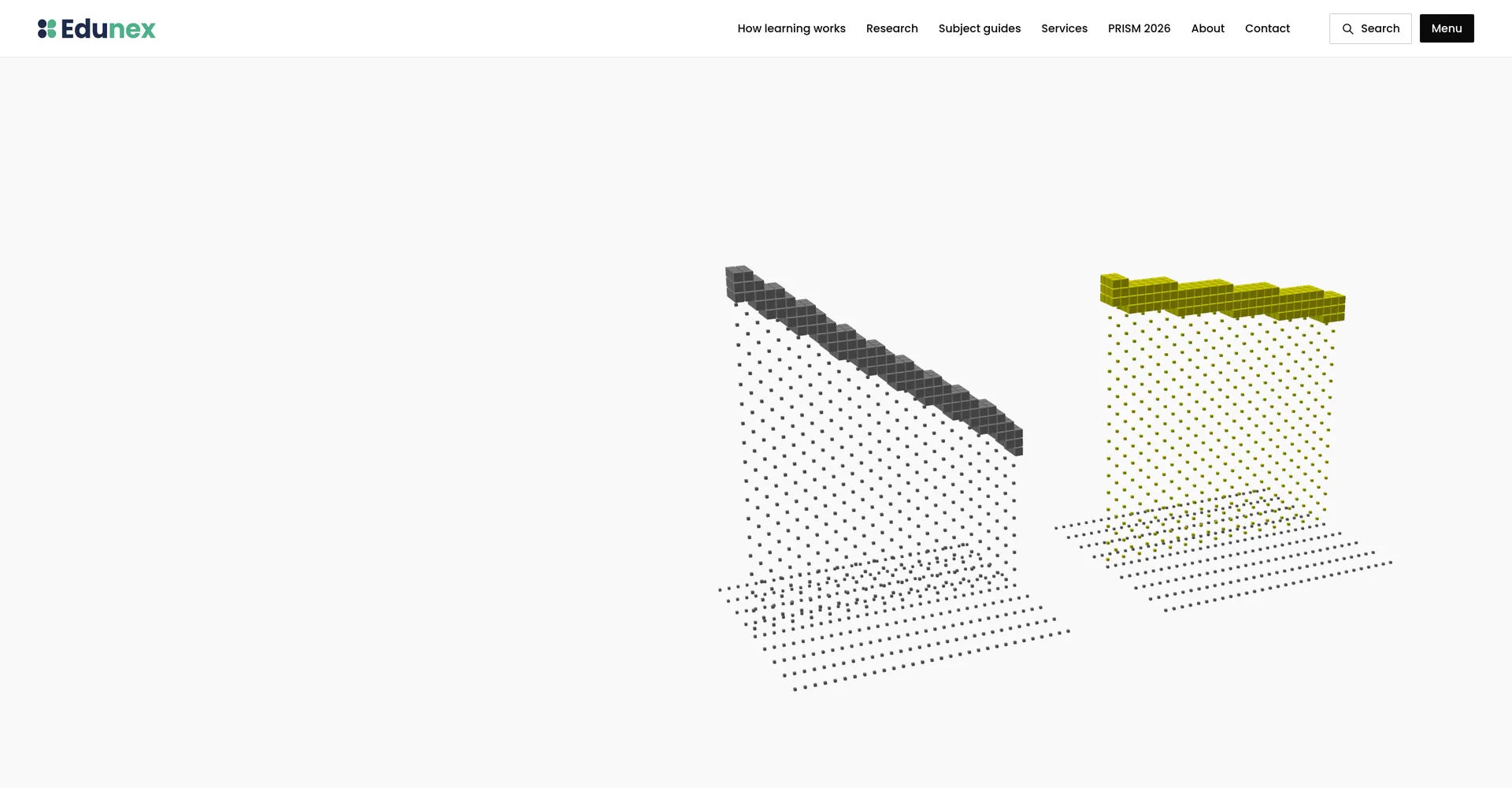
Days later, material that students have recalled from memory is remembered better than material they have studied again. The finding, known as the testing effect or retrieval practice, has been replicated in laboratories and classrooms, across age groups and subjects, and several large meta-analyses support it. It implies that the questions an institution already asks, if well designed, can be among its most effective means of teaching. This paper reviews the evidence, describes the conditions under which the effect is strongest (feedback, spacing, low stakes and effortful recall), notes its limits, and proposes six rules for asking students to recall, week by week and unit by unit.
Keywords: retrieval practice · recall · long-term memory · formative assessment · feedback
An instrument that changes what it measures
In most institutions a question put to a class is understood as a measuring instrument. Teaching comes first, and the answers record how much of it has stayed. Seen this way, asking is a cost. It takes time that could have gone to teaching, and an institution that asks often has given up some learning in exchange for information about learning.
The account holds only if answering leaves the student's memory as it was, and cognitive psychology finds that it does not. To retrieve something from memory is to change the memory, which becomes more durable and easier to retrieve again. Being asked is therefore a learning event as well as a measurement, and it is frequently more effective than the same time spent studying again.11For an accessible overview, see Brown, Roediger & McDaniel (2014), Make It Stick.
A question seen in this second way still measures. The difference is in how an institution should design its questions, when it should put them and how it should use the answers. All of it rests on one claim, which can be put to an experiment.
Five minutes and one week
2.1 The order reverses
The modern study of the effect is often traced to an experiment by Roediger and Karpicke.22Roediger & Karpicke (2006). The effect itself was observed much earlier; this study renewed interest in it. Students studied short prose passages in one of three ways: studying the passage in four periods; studying it in three and attempting to recall it in one; or studying it in one and attempting to recall it in three. A final test came either five minutes or one week later.
Had the experiment ended after five minutes, it would have favoured re-reading. Students who had studied in all four periods recalled 83% of the passage, against 71% for those who had spent most of their time recalling it. After a week the order reversed, to 40% and 61%. Two further details bear on institutions. The students who re-read predicted that they would remember more, and the group who practised recall had read the passage only once. Less exposure to the text had left more of it in memory.
2.2 Against a stronger rival
Re-reading is a weak rival. Karpicke and Blunt set retrieval against a stronger one, concept mapping, an active, elaborative technique widely recommended to teachers. Students who had practised retrieval later performed better, including on questions that required inference, so that what had been recalled could also be reasoned with. They did better even when the final test asked them to draw a concept map.33Karpicke & Blunt (2011), published in Science.
2.3 Hundreds of studies
A single experiment can mislead, but this effect has been examined in hundreds of studies. Several meta-analyses report that it is consistent: across many materials, formats and populations, being questioned produces better long-term retention than restudying.44Rowland (2014); Adesope, Trevisan & Sundararajan (2017). A review of ten common learning techniques rated practice testing as one of two with "high utility". The familiar techniques of re-reading and highlighting it rated low.55Dunlosky et al. (2013). The other high-utility technique was distributed practice.
2.4 Outside the laboratory
Many laboratory findings weaken in the conditions of an institution. This one has largely held. A systematic review of applied studies in schools and classrooms found that retrieval practice benefited learning in the large majority of cases, at levels from primary to university and across subjects.66Agarwal, Nunes & Blunt (2021). An institution that wants to design for the effect also needs some account of its cause.
Where the effect comes from
The mechanism is still debated. Three explanations are well supported, and each has consequences for the design of a question.
- Retrieval strengthens access. Many memory failures in the classroom are failures of retrieval: the knowledge was stored, and it cannot be found when it is needed. Attempting to recall exercises that search directly.
- Effort adds to the gain. Once some forgetting has occurred, retrieval takes effort, and effortful retrieval produces larger gains than retrieval that is easy. Bjork classes this as one of the "desirable difficulties".77Bjork (1994); Bjork & Bjork (2011).
- Retrieval reveals gaps. Re-reading creates familiarity, and students mistake familiarity for knowledge. An attempt at recall shows student and teacher alike what is not yet known.88Koriat & Bjork (2005); Karpicke, Butler & Roediger (2009).
The third has a literature of its own, on how students judge what they know. All three imply that some questions will teach less than others.
When recall does most
Questions differ in what they leave behind. The research identifies four conditions that strengthen the effect.
4.1 Feedback
Retrieval helps even without feedback. Feedback makes it more effective, especially for questions answered wrongly. With multiple-choice items it also guards against a particular danger, since a student who chooses a wrong option may otherwise learn it.99Butler & Roediger (2008).
4.2 Spacing
The same retrieval is more effective spaced over time than massed together. By that reasoning, a question about material from several weeks earlier should do more for long-term memory than one about last week.1010Cepeda et al. (2006). See also EL-WP-02.
4.3 Low stakes
The benefit comes from the act of retrieving, and none of the explanations above depends on the pressure of a result. Frequent questions with little at stake can produce the learning effect without the anxiety that attends a high-stakes result. There is even evidence that regular classroom retrieval practice can reduce students' test anxiety.1111Agarwal, D'Antonio, Roediger, McDermott & McDaniel (2014).
4.4 Effortful formats
Formats in which students produce an answer tend to give larger benefits than those that require only recognition, though well-constructed multiple-choice questions also help.1212Rowland (2014) found larger effects for recall formats; Adesope et al. (2017) found benefits for both. A mix is reasonable, on one condition. The recognition items have to make a student think about the alternatives, which depends on how the wrong options are written.
Six rules for asking
The step from evidence to a page of questions is a matter of judgement. The rules below are Edunex Labs' recommendations for what an institution asks each week and at the end of each unit, drawn from the literature above. They are not research findings in themselves, and an institution should judge them against its own context.
- Ask often, with little at stake. A short set of questions every week is likely to do more than an occasional long one. Low stakes keep its purpose on learning, and away from ranking students.
- Go back to earlier chapters every time. Each set should return to older material as well as the most recent chapter. A fixed share makes the return a regular part of the week.
- Ask students to produce answers. Short written answers belong alongside the multiple-choice items, whose wrong options should be plausible.
- Ask questions at each level of demand. Retrieving a fact strengthens memory for that fact, and memory without use is rote. Questions that require application and transfer give practice in using knowledge and reasoning with it, as later study also requires.1313See EL-WP-03 on classifying questions.
- Return the answer and the reason, soon. For every question, students should receive the correct answer and the reason for it shortly after answering. A score on its own loses much of what the question could teach.
- Let the answers decide what is taught next. Read by question and by concept as well as by student, they show what most of a class missed. That is retaught before the class moves on.
What recall cannot do
Three limits bear on institutional practice. Retrieval practice strengthens what is retrieved, so it depends on good initial teaching: a student cannot retrieve what was never understood. Some researchers have also argued that the effect shrinks for highly complex material, where many elements have to be integrated at once; this remains debated.1414van Gog & Sweller (2015), and responses to it in the same journal. And frequent questioning can do harm if it is high-stakes, publicly ranked or used to label students. The rules above are intended to avoid these uses.
The central conclusion stands within those limits. An institution that already questions its students can increase what the questions contribute to learning by changing how they are designed and used. What recall keeps, a mind can then reason with, since reasoning needs knowledge to work on. The second rule reaches beyond any one week to the year, the subject of The year around forgetting.
References
- Adesope, O. O., Trevisan, D. A., & Sundararajan, N. (2017). Rethinking the use of tests: A meta-analysis of practice testing. Review of Educational Research, 87(3), 659–701.
- Agarwal, P. K., D'Antonio, L., Roediger, H. L., McDermott, K. B., & McDaniel, M. A. (2014). Classroom-based programs of retrieval practice reduce middle school and high school students' test anxiety. Journal of Applied Research in Memory and Cognition, 3(3), 131–139.
- Agarwal, P. K., Nunes, L. D., & Blunt, J. R. (2021). Retrieval practice consistently benefits student learning: A systematic review of applied research in schools and classrooms. Educational Psychology Review, 33, 1409–1453.
- Bjork, E. L., & Bjork, R. A. (2011). Making things hard on yourself, but in a good way: Creating desirable difficulties to enhance learning. In M. A. Gernsbacher et al. (Eds.), Psychology and the real world (pp. 56–64). Worth.
- Bjork, R. A. (1994). Memory and metamemory considerations in the training of human beings. In J. Metcalfe & A. Shimamura (Eds.), Metacognition: Knowing about knowing (pp. 185–205). MIT Press.
- Brown, P. C., Roediger, H. L., & McDaniel, M. A. (2014). Make it stick: The science of successful learning. Harvard University Press.
- Butler, A. C., & Roediger, H. L. (2008). Feedback enhances the positive effects and reduces the negative effects of multiple-choice testing. Memory & Cognition, 36(3), 604–616.
- Cepeda, N. J., Pashler, H., Vul, E., Wixted, J. T., & Rohrer, D. (2006). Distributed practice in verbal recall tasks: A review and quantitative synthesis. Psychological Bulletin, 132(3), 354–380.
- Dunlosky, J., Rawson, K. A., Marsh, E. J., Nathan, M. J., & Willingham, D. T. (2013). Improving students' learning with effective learning techniques. Psychological Science in the Public Interest, 14(1), 4–58.
- Karpicke, J. D., & Blunt, J. R. (2011). Retrieval practice produces more learning than elaborative studying with concept mapping. Science, 331(6018), 772–775.
- Karpicke, J. D., Butler, A. C., & Roediger, H. L. (2009). Metacognitive strategies in student learning: Do students practise retrieval when they study on their own? Memory, 17(4), 471–479.
- Koriat, A., & Bjork, R. A. (2005). Illusions of competence in monitoring one's knowledge during study. Journal of Experimental Psychology: Learning, Memory, and Cognition, 31(2), 187–194.
- Roediger, H. L., & Karpicke, J. D. (2006). Test-enhanced learning: Taking memory tests improves long-term retention. Psychological Science, 17(3), 249–255.
- Rowland, C. A. (2014). The effect of testing versus restudy on retention: A meta-analytic review of the testing effect. Psychological Bulletin, 140(6), 1432–1463.
- van Gog, T., & Sweller, J. (2015). Not new, but nearly forgotten: The testing effect decreases or even disappears as the complexity of learning materials increases. Educational Psychology Review, 27(2), 247–264.
Edunex Labs working papers review published research and set out design implications. They do not report Edunex's own experimental results. Cite as: Edunex Labs (2026). What recall does: retrieval and the making of memory. Working paper EL-WP-01.